
Why Agency Analytics Reporting Takes So Much Time
For many marketing agencies, reporting day doesn’t feel like reporting. It feels like a second job.
You log into Google Analytics, check Google Ads, pull data from Meta, review social media performance, update spreadsheets, refresh charts, write explanations and finally send everything to the client.
Then you do it all again for the next client.
And the next one.
Individually, these tasks may only take a few minutes. But across multiple clients and marketing platforms, those minutes quickly become hours.
It’s easy to see how an agency could lose 10 hours every week simply building and delivering client reports. That’s around 520 hours a year spent on a process that could potentially be streamlined with a more automated approach to reporting.
The bigger question isn’t just how much time reporting takes.
It’s what your agency could be doing with those hours instead, something we explore further in our complete guide to AI-powered marketing analytics, reporting and campaign insights.
Where Do Those 10 Hours Actually Go?
Client reporting involves far more than putting numbers into a PDF.
A typical reporting workflow might look something like this:
Log in → collect data → export figures → organise data → check numbers → update charts → write commentary → format report → review → send
Now multiply that process across several clients.
Logging into multiple platforms
Marketing performance rarely lives in one place. An agency might need to access Google Analytics, Google Ads, Meta, Instagram, LinkedIn, SEO platforms and other tools to gather the information required for a single report.
Every platform has its own dashboard, metrics and reporting interface.
Exporting and collecting data
Once the relevant information is found, someone still has to collect it.
That could mean downloading CSV files, copying figures into spreadsheets, checking date ranges and gathering screenshots or other supporting information.
Cleaning and organising the numbers
Different platforms don’t always present information in exactly the same way.
Your team may need to check figures, align reporting periods, remove irrelevant data and make sure the numbers being presented are accurate and consistent.
Building the actual report
Then comes the report itself.
Charts need updating. Tables need formatting. Client branding may need adding. Previous-period comparisons need checking. Sections need rearranging.
And once the report is finished, the same process begins for another client.
Explaining what the numbers mean
Finally, someone needs to answer the question every client really cares about:
“So, what does this mean for my business?”
A list of metrics isn’t enough. Clients want to understand what changed, why it changed and what should happen next.
That’s where reporting can become particularly time-consuming.

1. Your Marketing Data Lives in Too Many Places
One of the biggest reasons agencies lose time on reporting is simple: the data is fragmented.
A client’s marketing activity may span search, paid advertising, social media, website analytics and SEO.
Instead of looking at one centralised view, an account manager may have to move between several platforms to collect the required information.
That creates unnecessary repetition.
It also makes it harder to see the bigger picture.
For example, you might see that website traffic increased in Google Analytics. But understanding whether that increase came from Google Ads, organic search, social media or another channel requires bringing information from different sources together.
A unified marketing data approach can make this process much more efficient.
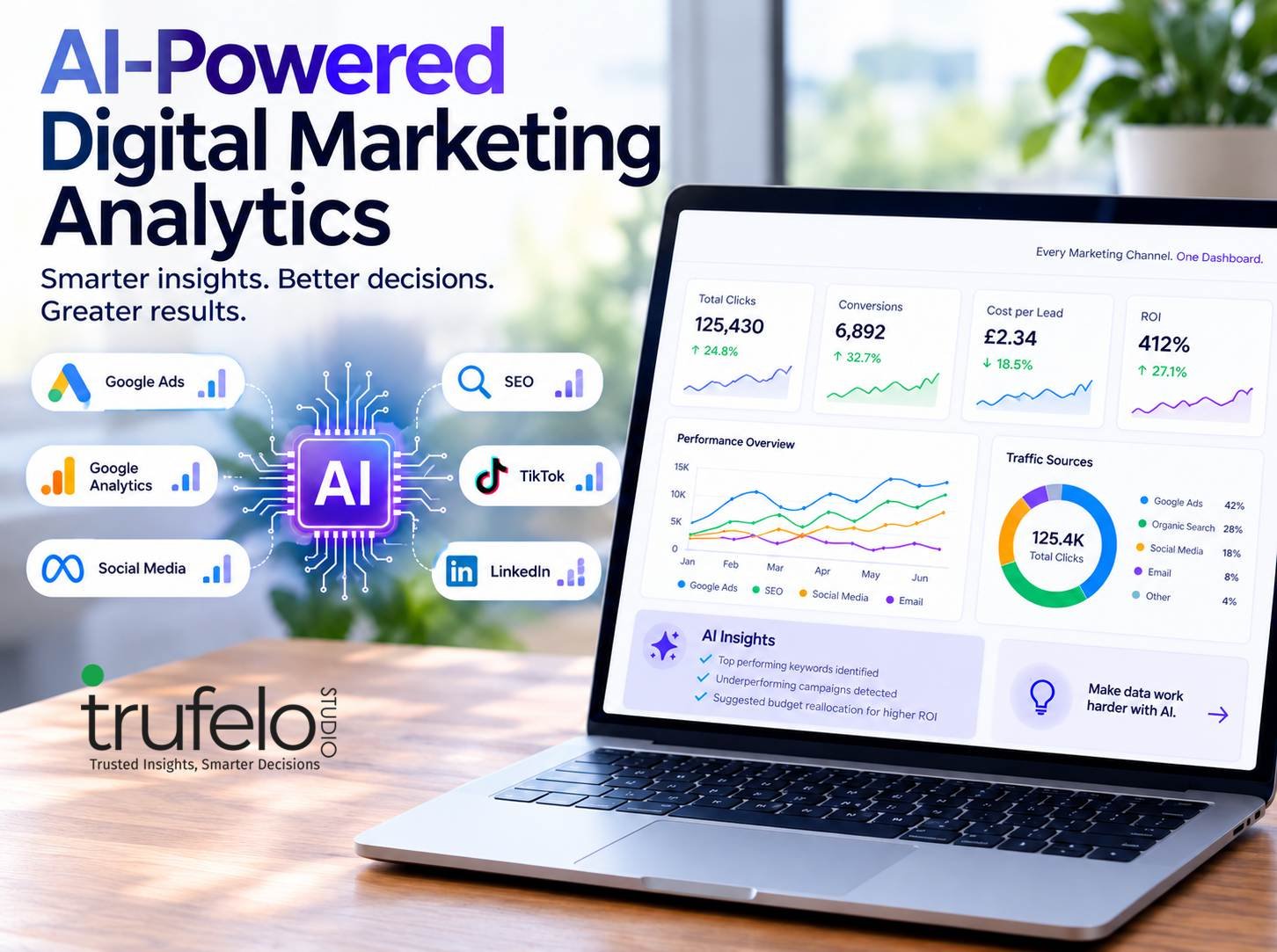
Instead of repeatedly switching between platforms, agencies can bring relevant marketing performance data together and analyse it in one place. This is really what Trufelo Studio is built around, Trufelo Studio is an agency analytics platform, allowing users to connect marketing and analytics data and view performance through a unified dashboard rather than piecing information together manually.
2. You’re Rebuilding the Same Report Every Week
Templates are supposed to make reporting easier.
But a template doesn’t necessarily eliminate the manual work behind it.
You may have a beautifully designed client report ready to go. The problem is that someone still has to update it.
The workflow might look like:
Open template → collect data → update figures → refresh charts → add commentary → check formatting → export → send.
And then you start again.
For one client, this might be manageable.
For ten clients, it becomes a significant operational task.
For a growing agency, manual reporting can become a serious scalability problem.
The frustrating part is that much of this work is repetitive. You’re not necessarily doing something strategically valuable each time you update a chart or copy a metric into a spreadsheet.
You’re repeating a process.
This is where automated client reporting can make a meaningful difference.
Rather than manually rebuilding reports every reporting period, agencies can use automated reporting workflows to collect relevant information, generate reports and schedule them for delivery. Our reporting platform is built specifically around this problem: agencies can select the metrics they need, set a reporting schedule and receive reports with AI-generated commentary without manually rebuilding the same report each time.
The goal isn’t to remove reporting from your agency.
It’s to remove unnecessary manual work from reporting.
3. Someone Has to Turn Numbers Into a Story
Data collection is only half the job.
Once you’ve gathered the numbers, someone still needs to interpret them.
A client doesn’t necessarily want to know that their click-through rate increased by 12%.
They want to know:
- Why did it increase?
- Which campaign contributed to the change?
- Is the improvement meaningful?
- What should we do next?
- Does anything need changing?
This is where reporting can consume even more agency time.
Account managers and strategists may spend significant time reviewing performance, identifying trends and writing explanations for every client.
And while this analytical work is valuable, there’s a difference between strategic analysis and repeatedly performing basic data interpretation.
AI-powered analytics can help reduce some of that repetitive groundwork. This is something we go into in more detail in our piece on whether AI-powered analytics are replacing traditional marketing dashboards, it’s designed to help users ask questions about their marketing data in plain English and receive explanations and recommendations based on their connected data.
That doesn’t mean AI replaces the agency strategist.
Instead, it can help the strategist get to the useful information faster.
The agency can then spend more time deciding what action to take rather than manually working through every number before the real analysis even begins.
For a broader explanation of how this approach works, our complete guide to AI-powered marketing analytics, reporting and campaign insights provides additional context.
4. Every Client Wants a Different Report
There’s another problem agencies quickly discover as they grow:
No two clients are exactly the same.
One client might care most about SEO performance.
Another might focus on Google Ads leads and return on ad spend.
A third might be primarily interested in social media engagement.
Another might want website traffic, conversions and campaign profitability.
This means agencies often have to create or maintain different reporting structures for different clients.
You may need to change:
- KPIs
- Channels
- Date ranges
- Charts
- Dashboards
- Branding
- Reporting frequency
- The level of detail
Customisation is important because clients don’t want to receive irrelevant information.
But customisation shouldn’t necessarily mean rebuilding the reporting process from scratch every time.
Our reporting platform allows users to select the KPIs, traffic channels and time ranges that matter to each report, using the custom report builder, so agencies can create reporting views that are relevant to individual clients while keeping the underlying process more streamlined.
For agencies doing a lot of search reporting, the dedicated SEO analytics and reporting solution is particularly relevant because it supports automated reports, custom dashboards, scheduled delivery and white-label reporting. And for accounts running paid social or search campaigns, the Google Ads reporting and social media reporting tools cover the channel-specific breakdowns clients tend to ask for most.
5. Reporting Is Still a Manual Process
Perhaps the biggest issue is that agencies have automated almost everything except reporting.
Think about it.
Campaigns can be automated.
Email sequences can be automated.
Lead notifications can be automated.
Ad optimisation can be supported by automation and AI, as we’ve covered in how to identify and scale your most profitable campaigns in real time.
But when reporting day arrives, someone says:
“I’ll update the spreadsheet.”
That’s where the hours disappear.
Manual reporting creates a recurring cycle:
Remember → Collect → Build → Check → Send
A more streamlined reporting process looks different:
Set up → Schedule → Review → Act
The difference is significant.
When reports can be generated and delivered automatically, the agency doesn’t need to remember to perform the same administrative tasks every week or month.
Our reporting system allows users to create custom reports and schedule them for daily, weekly or monthly delivery, with AI-generated commentary included.
If much of your reporting workload currently comes from Google Analytics, our Google Analytics reporting solution is especially relevant. It is designed to bring GA4 data into a simpler reporting environment and automate recurring reports rather than requiring manual exports and chart building.
The objective isn’t simply to produce reports faster.
It’s to change reporting from a recurring administrative task into a more streamlined workflow.
The Real Cost of Losing 10 Hours Every Week
Ten hours might not sound like a huge number.
But consider what it represents over a year.
10 hours × 52 weeks = 520 hours.
That’s more than thirteen standard 40-hour working weeks.
And the cost isn’t simply the number of hours spent creating reports.
It’s the opportunity cost.
Those same hours could be spent:
- Optimising campaigns
- Testing new strategies
- Improving SEO performance
- Analysing customer behaviour
- Speaking with clients
- Identifying new opportunities
- Developing creative campaigns
- Improving client retention
- Generating new business
For agency owners, this becomes particularly important.
If your team spends hours performing repetitive reporting tasks, increasing the number of clients can also increase the amount of administrative work required to support those clients.
That’s not an ideal way to scale.
The objective should be to increase client value without proportionally increasing repetitive operational work.
And reporting is one area where automation can help.

How Trufelo Helps Agencies Take Reporting Off Their To-Do List
The purpose of reporting isn’t to produce another spreadsheet.
It’s to help agencies and their clients understand marketing performance and make better decisions.
That’s where Trufelo Studio fits into the workflow as an effective agency analytics alternative.
Instead of treating reporting as a series of disconnected manual tasks, Trufelo brings together marketing data, dashboards, AI-powered insights and reporting capabilities in one environment.
The workflow can be thought of as:
1. Connect
Bring relevant marketing data into the platform.
2. Centralise
View performance data from multiple marketing channels in one place.
3. Analyse
Use dashboards and AI-powered analytics to identify performance changes, trends and opportunities.
4. Build
Create reports around the KPIs that matter to each client.
5. Automate
Schedule recurring reports rather than manually rebuilding them every reporting period.
6. Act
Use the time saved to focus on strategy, optimisation and client growth.
Our marketing reporting platform supports custom KPI selection, flexible reporting schedules and AI-generated commentary. Reports can be scheduled daily, weekly or monthly and delivered automatically.
This changes the role of reporting.
Instead of:
“How long will it take us to build this month’s reports?”
The question becomes:
“What can we learn from this month’s performance, and what should we do next?”
That’s where agencies create real value.
What Would Your Agency Do With 10 Extra Hours?
Imagine getting ten hours back every week.
What would you do with them?
Would your account managers spend more time with clients?
Would your SEO team have more time to identify growth opportunities?
Could your PPC specialists run more tests?
Could your strategists spend more time analysing campaign profitability?
Could your business development team pursue more opportunities?
The value of reporting automation isn’t simply the hours removed from a spreadsheet.
It’s what your team can accomplish with those hours instead.
Stop Building Reports. Start Using Them.
Client reporting is essential.
It demonstrates performance, builds transparency and gives clients a clear view of the work their agency is doing.
But producing reports doesn’t have to mean spending hours every week collecting data, updating spreadsheets, formatting charts and writing repetitive summaries.
The problem becomes even bigger as an agency takes on more clients and more marketing channels.
If your team is spending a significant amount of time creating reports, it’s worth looking at how the reporting process works — not just the report itself.
Centralised data, automated reporting, custom dashboards and AI-powered insights can help agencies move away from repetitive reporting administration and towards more valuable strategic work.
Because your agency’s value isn’t measured by how quickly you can copy numbers into a report.
It’s measured by what you do with those numbers.
If you’re ready to spend less time building reports and more time improving marketing performance, explore how Trufelo can help streamline your agency’s reporting workflow.
Frequently Asked Questions
How much time do agencies spend creating client reports?
The amount varies depending on the number of clients, marketing channels, KPIs and the reporting process. For agencies relying heavily on manual data collection and report creation, the hours can quickly add up each week.
Why does client reporting take so long?
Reporting can involve collecting information from multiple platforms, checking and organising data, updating charts and tables, writing analysis, formatting reports and delivering them to clients.
How can marketing agencies automate client reporting?
Agencies can use reporting platforms that centralise marketing data, generate reports automatically and schedule them for delivery. This reduces the amount of repetitive manual work required for each reporting cycle.
What should an agency client report include?
A useful client report should focus on the KPIs that matter to the client’s business. It should ideally explain performance trends, highlight important changes and provide actionable insights rather than simply presenting large amounts of data.
Can AI help with agency client reporting?
Yes. AI-powered analytics can help identify trends, explain performance changes and summarise marketing data. Human strategists should still provide context, judgement and strategic recommendations.
Trufelo Studio is an AI-powered analytics and marketing intelligence platform dedicated to helping businesses understand their digital performance through clear insights, automated reporting, and data-driven strategies. Our content is focused on simplifying analytics, SEO, advertising, and marketing for growing businesses.
Trufelo Studio
Trufelo Studio is an AI-powered analytics and marketing intelligence platform dedicated to helping businesses understand their digital performance through clear insights, automated reporting, and data-driven strategies. Our content is focused on simplifying analytics, SEO, advertising, and marketing for growing businesses.