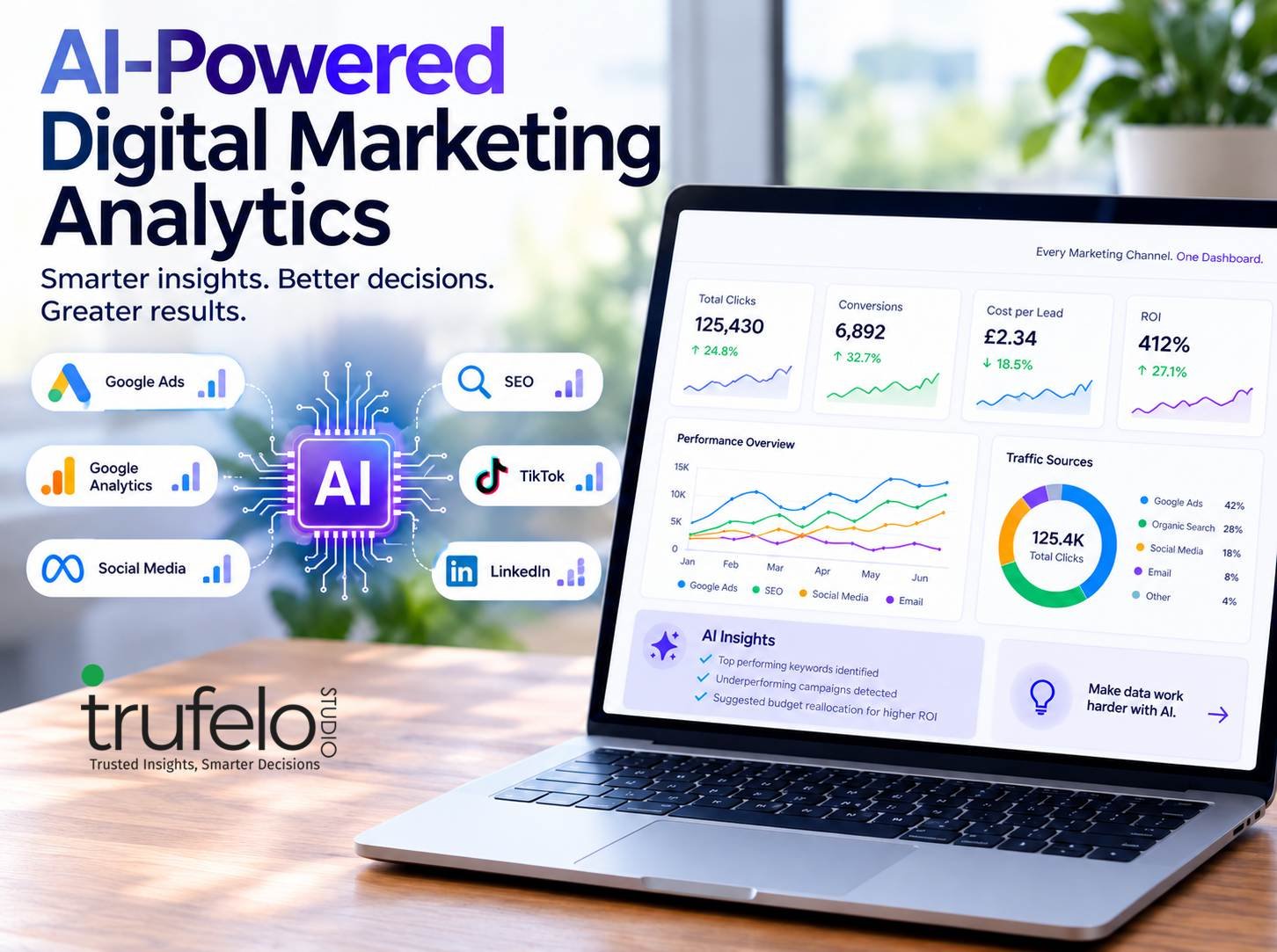
How AI transforms marketing data into actionable insights, simplifies reporting and helps businesses make smarter marketing decisions.
Your business has access to more marketing data than ever before. But can you confidently explain which campaigns are generating customers, which channels are wasting budget, and what you should improve next?
Most businesses now run marketing activity across Google Ads, Facebook, Instagram, SEO and a website analytics platform, often at the same time. Each channel produces its own dashboard, its own metrics and its own version of success. The result is a lot of data and very little clarity. Having more numbers does not automatically mean having better insight. It is entirely possible to track hundreds of metrics and still struggle to answer a simple question: which marketing activities actually generate leads, customers and revenue.
This is where AI-powered digital marketing analytics is changing how businesses understand performance. Rather than replacing human judgement, AI helps organise fragmented data, surface meaningful patterns and explain performance changes in plain language, so decisions can be made faster and with more confidence. This guide explains what AI-powered marketing analytics actually is, how it works, which metrics matter most, and how to use it to make better marketing decisions across SEO, paid advertising, social media and website performance.
Table of Contents
- What Is AI-Powered Digital Marketing Analytics?
- The Most Important Marketing Metrics Every Business Should Track
- Key Benefits of AI-Powered Marketing Analytics for Businesses
- How Does AI Marketing Analytics Work?
- AI Marketing Analytics Across Different Digital Marketing Channels
- Marketing Analytics Software vs Spreadsheets, Which Is Better?
- Marketing Analytics vs Business Intelligence
- How to Turn Marketing Data Into Actionable Insights
- How to Choose the Right AI Marketing Analytics Platform
- Common AI Marketing Analytics Mistakes to Avoid
- The Future of AI-Powered Marketing Analytics
- Frequently Asked Questions About AI-Powered Marketing Analytics
- How Trufelo Studio Can Help You Understand Your Marketing Performance
What Is AI-Powered Digital Marketing Analytics?
Understanding Digital Marketing Analytics
Digital marketing analytics is the process of collecting, measuring and evaluating data from marketing activity to understand what is working and what is not. This typically includes data from your website, search engines, paid advertising platforms and social media channels. Businesses use this data to track performance indicators such as traffic, conversions, cost per lead and return on ad spend, so decisions are based on evidence rather than guesswork.
How Artificial Intelligence Changes Marketing Analytics
Traditional analytics tells you what happened. AI adds the ability to identify trends, flag unusual changes and connect relationships between metrics that would be difficult to spot manually. It is useful to understand analytics in four layers:
- Descriptive analytics: what happened, such as last month’s clicks or conversions.
- Diagnostic analytics: why it happened, such as a drop in conversion rate linked to a landing page change.
- Predictive analytics: what is likely to happen next, based on current trends.
- Prescriptive analytics: what action is recommended, based on the data available.
AI also plays a growing role in translating complicated reports into plain-language explanations, helping marketing managers and business owners understand performance changes without needing to interpret raw charts themselves.
Navigating these complex reports can sometimes be challenging due to the abundance of technical jargon. To help you better understand these concepts, you can refer to our AI marketing analytics glossary for clear definitions of common metrics and reporting terms.
Traditional Analytics vs AI-Powered Analytics
| Factor | Traditional Analytics | AI-Powered Analytics |
| Manual analysis required | High | Reduced |
| Reporting speed | Slow, often manual exports | Faster, largely automated |
| Insight discovery | Depends on the analyst’s time and skill | AI highlights patterns and anomalies automatically |
| Recommendations | Not typically provided | Plain-language explanations and suggested actions |
For a closer look at how this shift is playing out in practice, see how AI-powered analytics compares with traditional marketing dashboards.
The Most Important Marketing Metrics Every Business Should Track
Not every metric deserves equal attention. Businesses get more value from tracking a smaller set of commercially relevant metrics than attempting to monitor everything available.
Website and SEO Performance Metrics
- Organic traffic and search visibility
- Website engagement, such as time on page and bounce rate
- Conversion rate from organic visitors
- Organic enquiries and leads generated
Businesses relying on organic search often benefit from a dedicated SEO analytics software solution that connects search visibility directly to conversions and other marketing channels, rather than reviewing SEO performance in isolation.
Paid Advertising Performance Metrics
- Cost per click (CPC)
- Cost per acquisition (CPA)
- Conversion rate
- Return on ad spend (ROAS)
Social Media Marketing Metrics
- Reach and engagement
- Click-through rate
- Leads and conversions generated through social channels
Revenue and Profitability Metrics
- Customer acquisition cost (CAC)
- Marketing return on investment (ROI)
- Revenue attributed to marketing activity
- Lead-to-customer conversion rate
Understanding which touchpoints influence a sale is easier with proper marketing attribution, which connects earlier interactions to the final conversion.
Key takeaway: prioritise metrics connected to commercial outcomes, such as leads, customers and revenue, rather than tracking every available number simply because it exists.
Key Benefits of AI-Powered Marketing Analytics for Businesses
Save Time With Automated Marketing Reporting
Automated reporting removes much of the repetitive exporting, formatting and spreadsheet preparation that marketing teams and agencies spend hours on each week. This is explained in more detail in how agencies lose hours every week creating client reports.
Understand Campaign Performance Faster
Instead of manually scanning every dashboard, AI highlights the changes that genuinely require investigation, so attention goes to what matters rather than what is simply unusual.
Make More Informed Marketing Budget Decisions
Clear visibility of channel-level performance and acquisition costs makes it easier to decide where budget should be increased, reduced or reallocated. This supports more deliberate campaign optimisation rather than reactive adjustments.
Connect Marketing Activities With Business Results
Impressions and clicks are easy to generate but do not necessarily reflect commercial success. AI-powered analytics helps bridge the gap between early-funnel activity and actual enquiries, customers and revenue.
Make Analytics More Accessible to Non-Technical Users
Plain-language explanations mean business owners do not need to be data analysts to understand performance. This is particularly useful for teams who want to understand their marketing performance without relying entirely on an external agency’s interpretation.
How Does AI Marketing Analytics Work?
While only a limited number of tools available that bring data from multiple marketing channels together in one dashboard, Trufelo Studio, a comprehensive analytics platform, goes a step further, combining an AI Data Analyst with advanced AI reporting features that allow users to explore data through natural-language questions and generate actionable insights beyond standard dashboards.
Step 1: Connect Your Marketing Data Sources
The platform connects to the marketing channels a business already uses, such as Google Ads, Facebook Ads, SEO tools and website analytics. This creates one consolidated source of data instead of several disconnected dashboards.
Step 2: Organise and Analyse Marketing Performance
Data from different sources is standardised and mapped against consistent metrics, so a click means the same thing whether it came from Google or Facebook. The platform then analyses performance trends across channels, compares campaigns, and flags changes that fall outside normal patterns.
Step 3: Generate AI-Powered Insights
Rather than only displaying numbers, AI explains what the numbers suggest. For example, it may highlight that a decline in conversions coincided with a rise in cost per click, and suggest this as a possible cause worth investigating. It is important that these are treated as observed patterns, not automatically confirmed causes, since marketing performance is often influenced by more than one factor at once.
Step 4: Turn Insights Into Marketing Actions
The final step is action. This typically involves prioritising which issues to address first, adjusting budget allocation, improving targeting or landing pages, and then measuring whether those changes produced better results. This creates a continuous feedback loop rather than a static report.
Suggested visual: Data Collection > AI Analysis > Actionable Insights > Better Decisions.
AI Marketing Analytics Across Different Digital Marketing Channels
SEO Analytics: Understanding Organic Search Performance
SEO reporting often involves tracking organic traffic, understanding which pages attract visitors, and measuring how many of those visitors convert into enquiries. The challenge is connecting SEO performance to actual business outcomes rather than visibility alone. A dedicated SEO analytics software solution helps bring these threads together alongside other marketing data.
Website Analytics: Going Beyond Basic Traffic Reports
Website analytics should cover visitors, traffic sources, user behaviour and conversion journeys, not just page views. Many business owners find standard analytics platforms difficult to interpret, a problem explored in why GA4 confuses 90 percent of business owners. This is why some businesses look for a Google Analytics alternative tool that presents the same underlying data in a clearer, more actionable way.
Facebook and Instagram Analytics: Measuring Social Media Impact
Social advertising reporting typically involves reach, clicks, engagement, cost per lead and campaign conversions, often across both Facebook and Instagram at once. Comparing results across platforms and preparing client-ready reports can be time-consuming without the right tools. Purpose-built Facebook reporting software simplifies this by consolidating performance into a single, understandable view, alongside broader social media reporting.
Google Ads Analytics: Understanding Advertising Profitability
Google Ads performance depends on tracking CPC, CPA, conversions and ROAS together, not in isolation. Underperforming campaigns are often easy to miss when metrics are reviewed separately rather than compared. A consolidated Google Ads reporting tool makes it easier to identify which campaigns are genuinely profitable and which are quietly draining budget.
Marketing Analytics Software vs Spreadsheets, Which Is Better?
Where Spreadsheets Still Work Well
Spreadsheets remain practical for small datasets, one-off analysis, and simple budget tracking where the volume of data is manageable and the reporting need is occasional rather than recurring.
The Limitations of Manual Marketing Reporting
As marketing activity grows, spreadsheets become harder to maintain. Common issues include time-consuming manual data collection, formula errors, inconsistent reporting between team members, and difficulty comparing performance across channels that each export data differently.
When to Consider Centralized Marketing Analytics Software
Centralized marketing analytics software becomes valuable when your business relies on multiple marketing channels but struggles to turn the data into clear, actionable insights. If you regularly switch between Google Analytics Reports, Google Ads, social media platforms and SEO analytics tools to understand campaign performance, consolidating this information into one dashboard can save time and simplify decision-making. It is particularly useful when manual reporting becomes time-consuming, performance metrics are difficult to compare, or your team needs a clearer picture of which channels are generating traffic, leads and conversions.
As your marketing activities grow, unified analytics software can also help you identify trends, uncover opportunities for optimisation and make more informed, data-driven decisions. AI-powered solutions take this a step further by summarising performance, highlighting potential issues and helping you understand what the numbers mean without spending hours analysing spreadsheets. Platforms such as Trufelo Studio bring marketing data together, helping businesses monitor performance across channels and turn complex datasets into meaningful insights that support smarter marketing strategies and more efficient campaign management.
Marketing Analytics vs Business Intelligence
Marketing analytics focuses specifically on marketing activity, including acquisition, engagement, conversions and marketing ROI. Business intelligence (BI) is broader and considers organisational data across functions such as finance, operations and sales, often used for company-wide strategic decisions.
The two disciplines overlap where marketing performance feeds into revenue and profitability reporting. For most small businesses and marketing teams, a focused marketing analytics platform is more appropriate than a full BI system, since it directly answers marketing-specific questions without the overhead of enterprise-wide data infrastructure.
How to Turn Marketing Data Into Actionable Insights
Start With a Specific Business Question
Useful analysis begins with a clear question, such as: which advertising campaign generates the lowest-cost qualified leads, or why did conversions decline last month. Vague goals produce vague insights.
Identify Meaningful Performance Changes
Look specifically for changes in acquisition costs, conversion rates, revenue and lead quality, rather than reacting to every fluctuation in traffic or impressions.
Investigate Possible Causes
Compare time periods, recent campaign changes, audience performance and website conversion behaviour to understand what may be driving the change before making decisions.
Prioritise Improvements and Measure Results
Turn findings into specific, assigned actions, then measure whether those changes actually improve performance. This step is often skipped, which limits the value of the analysis.
Example scenario: a business notices advertising costs rising while leads remain flat. Rather than cutting budget immediately, an analytics platform can help investigate whether CPC, conversion rate or CPA is driving the change, so the right adjustment is made rather than a reactive one. Platforms built around real-time analytics make this kind of investigation faster.
How to Choose the Right AI Marketing Analytics Platform
Essential Features to Look For
- Multi-channel data integration
- Easy-to-understand dashboards
- Automated reporting
- AI-generated explanations and recommendations
- Conversion and ROI tracking
- Data privacy and security
- An interface accessible to non-technical users
Questions to Ask Before Choosing a Platform
- Does it support the marketing platforms you already use?
- Can it report on meaningful business outcomes, not just activity?
- Can it explain changes rather than only display charts?
- Is it suitable for your team’s technical skill level and reporting needs?
- Are integrations, pricing and data access transparent?
If you are evaluating options, it is worth reviewing why businesses choose Trufelo and comparing this against your specific reporting requirements and pricing before deciding.
Common AI Marketing Analytics Mistakes to Avoid
- Tracking too many metrics without a clear goal attached to each one
- Assuming correlation between two metrics means one caused the other
- Treating AI-generated recommendations as guaranteed answers rather than starting points for investigation
- Ignoring tracking accuracy and data quality issues before trusting the insights
- Focusing on traffic and engagement while overlooking revenue and profitability
- Failing to act on findings once they have been identified
Key takeaway: AI helps businesses interpret marketing performance, but good decisions still require reliable data, context and human judgement.
The Future of AI-Powered Marketing Analytics
Several trends are shaping where AI marketing analytics is heading. Conversational analytics, where users ask questions in everyday language rather than building reports manually, is becoming more common. Predictive analytics is gradually becoming more accessible to smaller businesses rather than being limited to large enterprise teams. Automated detection of performance anomalies is improving, and cross-channel reporting is increasingly expected rather than optional.
Privacy-conscious data collection is also becoming more important as regulations and platform policies evolve. Over time, AI-assisted recommendations are likely to become a more routine part of everyday marketing workflows, though businesses should treat these as developing capabilities rather than finished, guaranteed outcomes.
Frequently Asked Questions About AI-Powered Marketing Analytics
What is AI-powered marketing analytics?
AI-powered marketing analytics uses artificial intelligence to analyse marketing data from channels such as Google Ads, Facebook and SEO, identifying patterns, anomalies and relationships. It explains performance changes in plain language and highlights where action may be needed, rather than only presenting raw charts and numbers.
How does AI improve digital marketing analytics?
AI improves marketing analytics by automating data organisation, spotting trends faster than manual review, and translating complex metrics into understandable explanations. This reduces the time spent interpreting dashboards and helps businesses focus on genuine performance issues rather than scanning every report manually.
What is the difference between traditional analytics and AI marketing analytics?
Traditional analytics displays data and relies on a person to interpret it manually. AI marketing analytics adds automated pattern detection, anomaly flagging and plain-language explanations, speeding up analysis and making insights more accessible to users without a data analysis background.
What is Trufelo Studio, and how does it help with marketing analytics?
Trufelo Studio is an AI-powered marketing analytics & reporting platform that brings marketing data from multiple channels into unified dashboards. It helps businesses monitor performance, understand trends and make data-driven decisions using AI-powered insights, an AI Data Analyst and automated reporting features.
Can small businesses benefit from AI marketing analytics software?
Yes. Small businesses often run marketing across multiple channels with limited time for manual reporting. AI marketing analytics software consolidates this data automatically, helping small teams understand performance without needing a dedicated analyst or spending hours building spreadsheets.
What are the most important marketing analytics metrics?
The most important metrics connect directly to business outcomes, including conversion rate, cost per acquisition, return on ad spend, customer acquisition cost and revenue attributed to marketing. These matter more than vanity metrics such as impressions or likes alone.
Can AI marketing analytics help improve ROI?
AI marketing analytics can support better ROI by identifying underperforming campaigns, highlighting rising acquisition costs, and surfacing where budget could be reallocated. It does not guarantee improved ROI, but it gives businesses clearer information to make more informed budget decisions.
Can AI-powered tools analyse Google Ads and Facebook campaign performance?
Yes, many AI marketing analytics platforms integrate directly with Google Ads and Facebook Ads, consolidating metrics such as CPC, CPA, conversions and ROAS into a single view. This makes it easier to compare performance across platforms rather than reviewing each one separately.
Is AI marketing analytics software better than spreadsheets?
For businesses managing multiple channels or recurring reporting, dedicated software is generally more efficient than spreadsheets, offering automation, scalability and faster insight generation. Spreadsheets remain suitable for small datasets or occasional, simple analysis.
Can AI analytics tools replace Google Analytics?
Some tools are built as standalone alternatives to Google Analytics. Trufelo takes a different approach, connecting directly with Google Analytics to add an additional reporting and interpretation layer on top of your existing data, rather than replacing it outright, as reflected in its current product setup.
How can businesses start using AI-powered marketing analytics?
Start by identifying which marketing channels and metrics matter most to your business, then connect those data sources to a platform that offers automated reporting and plain-language insights. Begin with a clear question you want answered, rather than trying to analyse everything at once.
How Trufelo Studio Can Help You Understand Your Marketing Performance
Bring Your Marketing Data Into One Place
Trufelo Studio brings supported marketing channels together into unified reporting, reducing the need to switch between separate dashboards for SEO, paid advertising and social media reporting.
Move From Complicated Dashboards to Clearer Insights
Instead of leaving business owners to interpret raw charts, Trufelo’s AI-assisted analysis helps explain performance changes and highlight areas that may be worth investigating further.
The AI Data Analyst feature in Trufelo Studio
Trufelo Studio’s AI Data Analyst allows users to explore their marketing data by asking questions in natural language, rather than manually navigating dashboards and reports. This helps marketers investigate performance changes, identify trends and obtain insights that support more informed marketing decisions.
Can Trufelo Studio generate AI-powered marketing reports?
Yes. Trufelo Studio offers AI-powered reporting features that help users create insightful marketing reports from their connected data sources. It also provides AI-generated summaries and commentary to make performance easier to understand, helping businesses and agencies communicate results without relying solely on standard dashboards or manual reporting.
Focus on Results That Matter
The emphasis is placed on enquiries, conversions, customer acquisition costs, campaign profitability and revenue, rather than surface-level engagement numbers alone.
Understanding your marketing performance shouldn’t require hours of switching between dashboards and spreadsheets. Trufelo Studio is designed to make marketing analytics more accessible, helping businesses and marketing teams move beyond disconnected numbers towards clearer insights and more confident decisions.
Explore Trufelo Studio and discover a simpler way to understand your marketing data.

Trufelo Studio is an AI-powered analytics and marketing intelligence platform dedicated to helping businesses understand their digital performance through clear insights, automated reporting, and data-driven strategies. Our content is focused on simplifying analytics, SEO, advertising, and marketing for growing businesses.