Learn how to simplify marketing reports, automate repetitive tasks and turn campaign data into clearer business decisions.
Marketing data rarely lives in one place. SEO performance sits in one dashboard, paid advertising sits in another, and social media and website analytics sit somewhere else entirely. Pulling all of this together every week or month takes hours that most marketing managers and business owners simply don’t have.
The problem isn’t a lack of data. It’s too much of it, spread across too many platforms. This fragmentation is exactly why so many business owners find standard analytics tools confusing rather than useful. Reporting on clicks, impressions and website visits alone doesn’t explain whether marketing is actually growing the business.
Connected analytics and marketing reporting automation change this. They pull scattered data into one place, standardise the numbers, and free up time for interpretation instead of data entry. Good marketing reporting isn’t about collecting more numbers. It’s about understanding what is working, why it’s working, and what to improve next.
Table of Contents
- What Is Marketing Reporting?
- Why Marketing Reporting Matters for Business Growth
- What Should a Marketing Report Include?
- Different Types of Marketing Reports and When to Use Them
- The Challenges of Manual Marketing Reporting
- How Automated Marketing Reporting Works
- How AI Is Changing Marketing Reporting
- How to Choose the Right Marketing Reporting Software
- Best Practices for Creating Marketing Reports That Drive Decisions
- Frequently Asked Questions About Marketing Reporting
- Make Marketing Reporting Faster, Clearer and More Actionable
What Is Marketing Reporting?
Marketing reporting is the structured process of collecting, organising and presenting marketing performance data so a business can understand how its campaigns and channels are performing. It typically covers metrics from SEO, paid advertising, social media and website analytics over a defined time period, such as a week, month or quarter.
A good report doesn’t just list numbers. It explains what those numbers mean for the business, whether that’s enquiries, sales, leads or brand visibility.
What Is the Purpose of a Marketing Report?
A marketing report exists to help a business evaluate performance, justify spending and identify opportunities for improvement. It gives marketing managers, business owners and agencies a shared reference point for decision making.
Reports also create accountability. They show whether campaigns are meeting targets, which channels are earning their budget, and where attention is needed next. Without this, marketing decisions tend to rely on assumptions rather than evidence.
Marketing Reporting vs Marketing Analytics
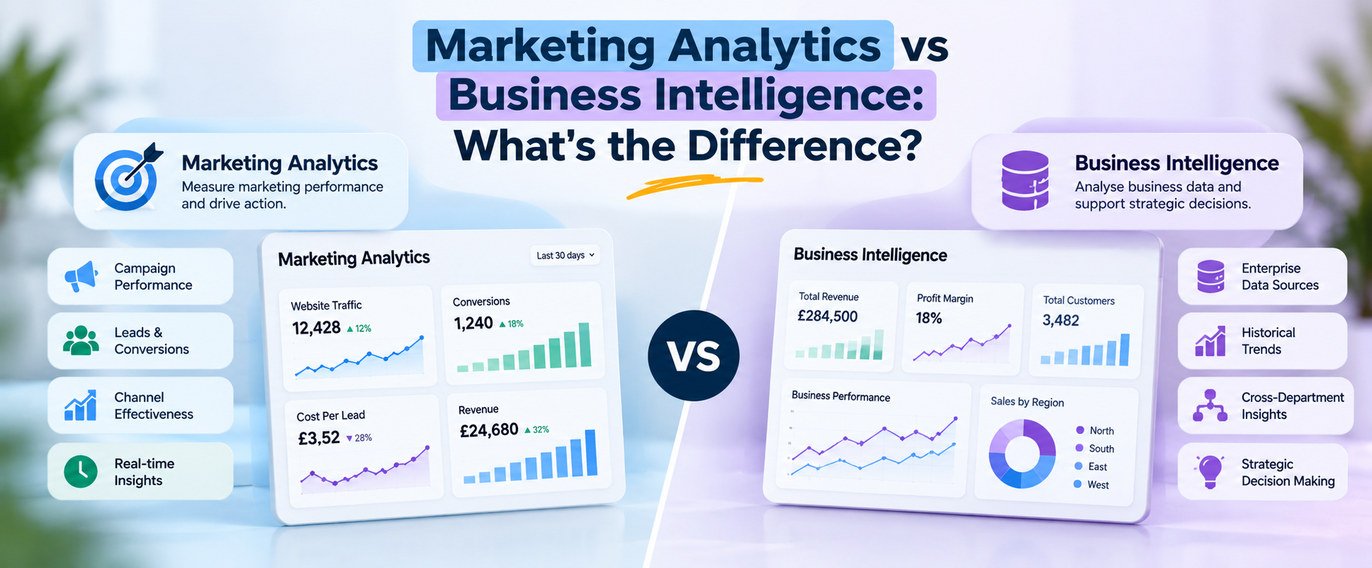
Marketing reporting shows what happened, while marketing analytics explains why it happened. The two work together but serve different purposes.
- Reporting: Summarises performance over a set period, such as traffic, conversions or ad spend.
- Analytics: Investigates the causes behind performance changes, such as a drop in conversion rate or a rise in cost per click.
- Actionable insights: Combine both to answer the practical question of what should happen next.
For a deeper look at how data is turned into decisions, see Trufelo’s guide to AI-powered analytics and how it transforms marketing data into actionable insights.
Why Marketing Reporting Matters for Business Growth
Effective marketing reporting matters because it turns scattered campaign activity into decisions that directly support revenue and growth. Without reporting, businesses often continue spending on channels that aren’t delivering, simply because no one has compared the results clearly.
Understand Which Marketing Channels Deliver Results
Comparing SEO, paid advertising, social media and website performance side by side shows which activities actually generate enquiries and sales. This stops budget being spread evenly across channels regardless of performance.
Make Better Marketing Budget Decisions
Reporting highlights inefficient spending and stronger performing campaigns. A business can then shift budget towards the channels proven to produce results, rather than guessing based on gut feeling.
Improve Accountability and Communication
Clear, understandable reporting gives business owners, marketing teams and agencies a shared set of facts. This reduces disagreements about performance and keeps everyone focused on the same goals.
Identify Problems Before They Become Expensive
Regular reporting catches changes in conversion rate, cost per acquisition or campaign performance early. Spotting a problem in week one is far cheaper than discovering it three months into a declining campaign.
What Should a Marketing Report Include?
A useful marketing report includes a summary of results, relevant KPIs, a breakdown of channel performance, and clear next steps. Each section should connect back to the business goal the report is measuring against.
Executive Summary and Key Findings
This section highlights overall performance, significant changes and recommended actions. It should be readable in under two minutes by someone who hasn’t looked at the raw data.
Marketing Goals and Relevant KPIs
Metrics should be selected based on the business objective, whether that’s leads, sales, customer acquisition or revenue. Reporting every available metric without this filter creates noise rather than clarity. For guidance on choosing the right numbers, see what marketing metrics business owners should actually track.
Channel Performance Overview
Each channel contributes differently, so reports should break down performance by source rather than blending everything into one total.
| Channel Key Metrics What It Shows | ||
| SEO | Organic traffic, search visibility, conversions | Long-term visibility and organic demand |
| Google Ads | Ad spend, CPC, conversions, CPA, ROAS | Paid search efficiency and return |
| Facebook and Instagram | Reach, engagement, traffic, attributed conversions | Social awareness and audience response |
| Website Analytics | Traffic sources, engagement, conversion rate | How visitors behave once they arrive |
Businesses tracking SEO performance in detail typically use dedicated SEO analytics software to monitor rankings, organic traffic and conversions in one place. Social platforms are often reported separately through tools such as Facebook reporting software, which pulls reach, engagement and attributed conversions into a single view. For website behaviour, many teams compare GA4 against a more accessible Google Analytics alternative tool that presents conversion data without the steep learning curve. Paid search performance, meanwhile, is typically tracked through a dedicated Google Ads reporting tool that consolidates spend, CPC and ROAS into one dashboard.
Insights and Next Steps
Every useful report answers three questions: what changed, why it matters, and what to do next. A report that stops at “traffic increased 12%” without context leaves the reader to guess what action, if any, is needed.
Different Types of Marketing Reports and When to Use Them
The right reporting frequency depends on how time-sensitive the campaign is and who the report is for. Daily, weekly and monthly reports each serve a different purpose.
| Report Type Main Focus Best Suited For | ||
| Daily | Spend, significant changes, time-sensitive campaigns | Active paid campaigns and launches |
| Weekly | Short-term trends and immediate adjustments | Campaign optimisation and quick decisions |
| Monthly | Progress against targets, revenue, strategy | Stakeholder updates and planning |
Daily Marketing Reports
Daily reports are useful for monitoring time-sensitive campaigns, tracking spend and catching significant changes before they escalate. They suit paid advertising during active promotions or product launches.
Weekly Marketing Reports
Weekly reports focus on short-term trends, campaign adjustments and immediate priorities. They give teams enough time to act without reacting to every daily fluctuation.
Monthly Marketing Reports
Monthly reports cover progress against targets, channel contributions, conversions, revenue and strategic recommendations. These are usually the main reports shared with business owners or clients.
Client Reports vs Internal Marketing Reports
Client reports tend to focus on outcomes, clear visuals and plain-English summaries, since the audience may not be familiar with marketing terminology. Internal reports often include more granular data, since the team using them needs the detail to make operational decisions.
The Challenges of Manual Marketing Reporting
Manual marketing reporting is time-consuming and prone to error because it relies on pulling data from multiple platforms by hand. Many teams lose more time preparing reports than acting on them.
Data Scattered Across Multiple Platforms
Switching between separate dashboards for SEO, Google Ads, social media and website analytics makes it difficult to see the full picture in one view.
Time-Consuming Data Collection
Downloading exports, copying figures into spreadsheets and formatting charts can take hours every week. This is time that could otherwise go towards improving campaigns. Agencies in particular feel this pressure; one analysis found that agencies can lose up to 10 hours a week building client reports manually.
Inconsistent Metrics and Reporting Errors
Different platforms attribute conversions differently and use different reporting periods. Manually combining these numbers often introduces errors that undermine trust in the report.
Reports That Show Numbers Without Explaining Results
Teams spending most of their time assembling spreadsheets have little time left to interpret what the numbers actually mean. The result is a report full of figures but short on insight.
How Automated Marketing Reporting Works
Automated marketing reporting connects data sources directly to a central platform, standardises the metrics, and generates reports on a schedule without manual data entry. This removes most of the repetitive work involved in traditional reporting.
By utilising dedicated marketing reporting software, teams can centralise their data streams into a single source of truth.
Connect Your Marketing Data Sources
Reporting software pulls data directly from supported platforms, such as Google Analytics, Google Ads, Facebook and SEO tools, into one central reporting environment. This removes the need to log into each platform separately.
Standardise Metrics and Build Dashboards
Once connected, consistent KPIs, date ranges and campaign comparisons can be applied across every channel. This solves the inconsistency problem common in manual reporting.
Schedule Recurring Reports
Daily, weekly and monthly reports can be generated and delivered automatically, removing the need to rebuild the same report from scratch every period.
Turn Reporting Data Into Actionable Insights
Once the numbers are centralised, analytics and AI-assisted interpretation can help teams understand performance changes more quickly, rather than spending that time formatting spreadsheets.
How AI Is Changing Marketing Reporting
AI is changing marketing reporting by helping teams understand why performance changed, not just what the numbers were. This shifts reporting from a static summary into a more useful, interpretive tool.
With the rise of AI-powered marketing analytics, businesses can automatically surface trends that manual reporting would miss.
Moving Beyond Static Dashboards
Traditional dashboards display metrics but leave interpretation entirely to the reader. AI-assisted reporting adds context around the numbers, flagging what deserves attention.
Understanding Why Performance Changes
AI-assisted analysis can help identify patterns, anomalies and possible explanations behind performance shifts, such as a sudden drop in conversions or a spike in cost per click. These explanations still require human validation before action is taken.
Asking Questions About Marketing Performance
Natural-language reporting tools allow teams to ask direct questions, such as:
- Which campaign generated the most conversions?
- Why did our cost per acquisition increase?
- Which marketing channel performed best last month?
This replaces the process of manually filtering dashboards to find the answer.
Turning Insights Into Recommended Actions
Reporting that highlights likely causes and suggested next steps supports faster, evidence-based decisions, while human review remains essential before changing budgets or strategy.
How to Choose the Right Marketing Reporting Software
The right marketing reporting software connects all relevant data sources, allows customisable dashboards, and presents insights in plain English rather than raw figures alone. Evaluating a few key criteria makes the decision easier.
Multi-Platform Data Integration
Most businesses need reporting across SEO, website analytics, paid advertising and social media. Software that connects to all of these removes the need to switch between separate tools.
Customisable Dashboards and KPIs
Every business has different goals, so reporting software should adapt to track leads, sales or revenue rather than forcing a fixed set of metrics onto every user.
Automated Reporting and Scheduling
Recurring report generation reduces administrative work significantly. Reports that build and send themselves free up hours that would otherwise go into manual preparation.
AI-Powered Insights and Plain-English Explanations
Accessible reporting matters for non-technical business owners who need to understand performance without learning analytics terminology. Clear explanations alongside the numbers make reports genuinely usable.
Ease of Use, Data Privacy and Scalability
Usability, appropriate access controls, transparent pricing and support for growing teams all matter as a business scales its marketing activity. Platforms covering social media reporting software alongside paid and organic channels tend to suit businesses managing multiple platforms at once.
Best Practices for Creating Marketing Reports That Drive Decisions
The most useful marketing reports are built around clear objectives, consistent metrics and honest interpretation rather than raw data alone. These practices apply whether a report is built manually or generated automatically.
- Start with clear business objectives: Define what success looks like before choosing which metrics to track.
- Prioritise metrics connected to conversions and revenue: Vanity metrics like impressions matter less than outcomes tied to business growth.
- Use consistent reporting periods and definitions: Comparing like-for-like periods avoids misleading conclusions.
- Compare results against targets and previous periods: Context turns a number into a meaningful insight.
- Explain important changes instead of presenting numbers alone: A short explanation prevents misinterpretation.
- Include clear recommendations and responsible next steps: Every report should end with an action, not just a summary.
Frequently Asked Questions About Marketing Reporting
What is marketing reporting?
Marketing reporting is the process of collecting and presenting data from marketing channels, such as SEO, paid advertising, social media and website analytics, to show how campaigns are performing against business goals over a set period.
What KPIs should a marketing report include?
KPIs should match the business objective. Common choices include conversion rate, cost per acquisition, return on ad spend, organic traffic and revenue generated, rather than broad metrics like impressions alone.
How often should marketing reports be created?
Most businesses use weekly reports for short-term adjustments and monthly reports for strategic reviews. Daily reporting usually only applies to active, time-sensitive paid campaigns.
Can marketing reports be automated?
Yes. Reporting software can connect to marketing platforms, standardise metrics and generate scheduled reports automatically, removing the need for manual data collection and spreadsheet formatting.
What is the difference between marketing reporting software and analytics software?
Reporting software focuses on presenting what happened across campaigns and channels. Analytics software goes further, helping explain why performance changed and what factors contributed to it.
Make Marketing Reporting Faster, Clearer and More Actionable
Marketing reporting should do more than summarise campaign activity. Connected data gives a clearer picture of overall performance, while automation removes the repetitive work that eats into a marketing team’s week.
Meaningful KPIs connect day-to-day marketing activity to real business outcomes, and AI-assisted insights help teams identify what actually deserves attention, rather than reviewing every metric manually. Used together, these elements turn reporting from an administrative task into a genuine decision-making tool.
How Trufelo Studio Can Help
Trufelo Studio helps businesses and agencies simplify marketing reporting through unified analytics, automated marketing reports and accessible AI-powered insights. Instead of switching between SEO, Google Ads, Facebook and website dashboards, teams get one connected reporting environment built around the metrics that matter.
Explore how Trufelo Studio can help you spend less time preparing marketing reports and more time improving results.

Trufelo Studio is an AI-powered analytics and marketing intelligence platform dedicated to helping businesses understand their digital performance through clear insights, automated reporting, and data-driven strategies. Our content is focused on simplifying analytics, SEO, advertising, and marketing for growing businesses.