Stop tracking numbers that look impressive. Focus on the marketing metrics that reveal what’s driving leads, customers and revenue.
Are You Measuring Marketing Activity or Business Results?
Your website traffic is growing. Your social media engagement is up. Your ads are generating clicks. But is any of it bringing in more customers? Most marketing reports are full of numbers that look good on a slide but say very little about whether a business is actually growing. Impressions, clicks and website visits measure activity, not results.
Tracking too many metrics at once makes it harder, not easier, to spot what’s actually working. The solution isn’t more data. It’s choosing the right key performance indicators based on specific business goals. This article walks through the marketing metrics that genuinely matter, how to prioritise them by channel, and how AI-powered digital marketing analytics can help turn raw numbers into decisions you can act on.
Table of Contents
- Why Tracking More Metrics Doesn’t Always Mean Better Decisions
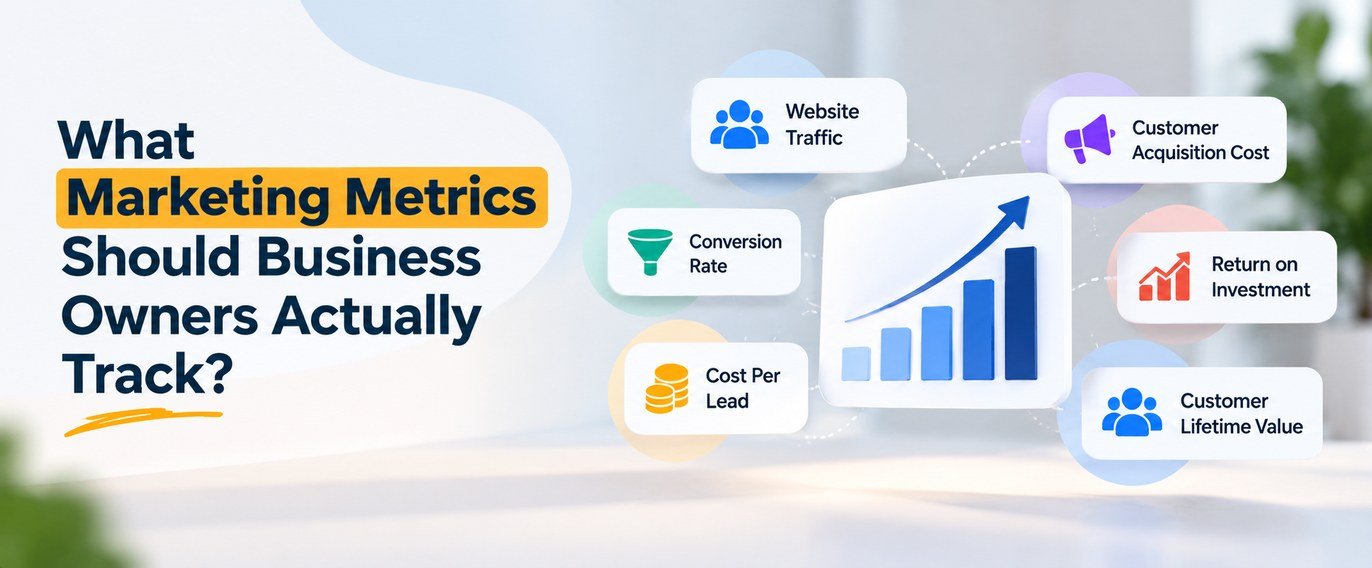
- The 7 Marketing Metrics Every Business Owner Should Prioritise
- Which Metrics Matter Most for Each Marketing Channel?
- How to Choose the Right Marketing KPIs
- How to Build a Simple Marketing Performance Dashboard
- Common Marketing Measurement Mistakes to Avoid
- How Trufelo Studio Helps You Focus on Results
- FAQ
Why Tracking More Marketing Metrics Doesn’t Always Mean Better Decisions
The Problem With Vanity Metrics
High impressions, likes and traffic feel reassuring, but they don’t confirm that marketing is profitable. These numbers are still useful for measuring awareness and reach. The issue is treating them as proof of success rather than one piece of a bigger picture.
The Difference Between Marketing Activity and Business Outcomes
Activity metrics, such as impressions, clicks and engagement, show that marketing is happening. Outcome metrics, such as qualified leads, customers and revenue, show whether that activity is actually paying off. A useful report connects the two, so a drop in leads can be traced back to a specific campaign or channel.
For example, a campaign generates 10,000 impressions and 500 clicks but produces only two enquiries. The click-through rate might look healthy, but on its own it cannot establish whether the campaign was successful. Without knowing what happened after the click, the business has no way of judging real performance.
The 7 Marketing Metrics Every Business Owner Should Prioritise
These seven metrics form the core of a results-focused marketing report. For full definitions of related terms, see the AI Marketing Analytics Glossary.
1. Qualified Leads: Are You Attracting Potential Customers?
Lead quality matters more than lead quantity. A general enquiry is not the same as a sales-qualified opportunity with budget, intent and fit. Track leads by source and campaign so you know which channels bring in prospects who actually convert. Fifteen qualified leads that convert at a healthy rate will outperform 100 irrelevant enquiries every time.
2. Conversion Rate: Are Visitors Taking Action?
Conversion rate measures meaningful actions, such as enquiries, bookings or purchases, as a proportion of visitors. It helps identify underperforming landing pages or campaigns before budget is wasted. A simple calculation: 50 conversions from 2,000 visitors is a 2.5% conversion rate.
3. Cost Per Lead (CPL): What Does Each Enquiry Cost?
CPL shows how efficiently a channel generates enquiries. A lower CPL is not automatically better if those leads rarely become customers. Always compare CPL alongside lead-to-customer conversion rates to understand true efficiency.
4. Customer Acquisition Cost (CAC): How Much Does It Cost to Win a Customer?
CAC includes relevant sales and marketing costs involved in acquiring a paying customer, not just ad spend. It is more commercially meaningful than cost per click alone, because it reflects the full journey. CAC should always be evaluated against customer value, not viewed in isolation.
5. Marketing-Attributed Revenue: Is Marketing Generating Sales?
This metric links revenue to the channels and campaigns believed to have influenced it. Attribution has limitations, particularly across multiple touchpoints, so consistent tracking rules matter. It’s worth distinguishing reported attribution, which is an estimate, from confirmed incremental revenue.
6. Marketing ROI: Is Your Marketing Investment Paying Off?
Marketing ROI measures financial return against total marketing cost, including labour and tools, not just media spend. It differs from ROAS, which looks purely at revenue versus ad spend. As a simple example, spending £2,000 on a campaign that generates £8,000 in attributed sales gives a 300% ROI.
7. Customer Lifetime Value (CLV): Are You Attracting Valuable Customers?
CLV accounts for repeat purchases and the long-term value of a customer relationship, not just the first sale. It helps determine a sustainable acquisition cost, since a higher CAC can be justified when CLV is strong. Reliable CLV estimates depend on accurate customer and financial data.
| Metric | Main business question |
| Qualified leads | Are we attracting the right prospects? |
| Conversion rate | Are visitors taking meaningful action? |
| Cost per lead | How efficiently are we generating enquiries? |
| Customer acquisition cost | What does it cost to win a customer? |
| Marketing-attributed revenue | Which activities are associated with sales? |
| Marketing ROI | Are our marketing investments profitable? |
| Customer lifetime value | What is a customer worth over time? |
Which Marketing Metrics Matter Most for Each Digital Marketing Channel?
Website Analytics: Measure Enquiries and Conversions
Prioritise overall conversion rate, key actions such as calls, bookings and form submissions, and which traffic sources actually produce qualified enquiries. A Google Analytics alternative tool can simplify this by presenting conversions in plain language rather than raw event data.
SEO Analytics: Measure Organic Leads, Not Just Rankings
Rankings alone don’t pay the bills. Focus on organic enquiries and conversions, how individual landing pages perform, and use search visibility as a supporting diagnostic rather than a headline KPI. SEO analytics software can connect ranking data to actual lead generation.
Google Ads: Track Acquisition Costs and Returns
Prioritise conversions and qualified leads, cost per acquisition or CAC, and ROAS where revenue attribution is reliable. A dedicated Google Ads reporting tool helps separate genuine performance from vanity click data.
Facebook and Instagram: Look Beyond Likes and Reach
Prioritise leads and conversions from paid campaigns, cost per qualified lead, and campaign-attributed revenue where measurable. Engagement and reach remain useful as supporting awareness indicators. Facebook reporting software makes it easier to separate awareness metrics from results that affect revenue.
How to Choose the Right Marketing KPIs for Your Business Goals
Step 1: Identify Your Main Business Objective
Common objectives include more enquiries, increased online sales, lower acquisition costs or improved customer retention. The objective should drive which metrics matter, not the other way around.
Step 2: Select 3 to 5 Primary KPIs
Choose only the metrics that directly indicate progress towards that objective. More KPIs do not mean better insight, they usually mean more noise.
Step 3: Add Supporting Diagnostic Metrics
Traffic, CTR, CPC and engagement remain useful for investigating why primary KPIs are moving, even though they shouldn’t be treated as success measures on their own.
Step 4: Establish Benchmarks and Review Regularly
Compare performance against your own historical results, targets and business economics, rather than generic industry averages that rarely reflect your actual customers or margins.
A local service business, for example, could prioritise qualified enquiries, booked appointments, new customers, CAC and marketing-attributed revenue as its primary KPIs.
How to Build a Simple Marketing Performance Dashboard
Bring Your Most Important Metrics Into One View
Focus on a small set of outcome-based KPIs, organise them by business goal and channel, and compare results across consistent reporting periods so changes are easy to spot.
Review What Changed and What Needs Attention
Identify shifts in leads, acquisition costs and conversions, investigate likely causes, and record the actions taken so you can monitor whether performance improves afterwards.
Use AI-Assisted Analytics to Simplify Interpretation
AI-powered reporting can help identify trends and anomalies faster than manual review, often summarising findings in plain language rather than raw figures. These findings should still be checked against business context, since AI can highlight patterns but can’t fully understand your market. Automated marketing reporting can bring these metrics into one consistent view instead of switching between separate platform dashboards.
Common Marketing Measurement Mistakes Business Owners Should Avoid
- Tracking every available metric without prioritisation
- Treating impressions or clicks as evidence of sales success
- Ignoring lead quality and customer acquisition costs
- Comparing platforms without consistent attribution rules
- Overlooking tracking gaps and offline conversions
- Making major budget decisions from short-term fluctuations
Key takeaway: Good measurement means tracking the right numbers, understanding their limitations and using them to make decisions, not collecting data for its own sake.
How Trufelo Studio Helps You Focus on Marketing Results That Matter
Understand Performance Across Your Marketing Channels
Trufelo Studio consolidates analytics from supported marketing sources into one place, so you’re not switching between platforms to piece together what’s actually happening.
Spend Less Time Interpreting Complicated Reports
AI-assisted insights help translate raw data into plain-language summaries, making it easier to understand marketing data without needing to be a data analyst.
Make More Informed Marketing Decisions
By focusing on conversions, acquisition costs and marketing performance rather than surface-level activity, you can make budget and strategy decisions with more confidence.
Tracking more marketing metrics doesn’t automatically mean understanding your marketing better. The real value comes from knowing which activities generate qualified leads, customers and revenue, and which need improvement. Trufelo Studio helps businesses bring their marketing performance into focus, making it easier to move beyond disconnected reports towards clearer, more informed decisions.
Explore Trufelo Studio and discover how AI-powered analytics can help you understand what’s working in your marketing.
FAQ
What is the most important marketing metric for small businesses?
There isn’t one universal answer, but qualified leads and customer acquisition cost are usually the most useful starting point, since they connect marketing activity directly to business growth and profitability.
How many marketing KPIs should a business track?
Most businesses do best with 3 to 5 primary KPIs tied directly to their main objective, supported by a handful of diagnostic metrics like traffic or CTR to help explain changes.
Is marketing ROI the same as ROAS?
No. ROAS compares revenue to ad spend only, while marketing ROI accounts for total marketing costs, including labour and tools, giving a more complete picture of profitability.
Why do my website traffic and conversions not match?
Traffic growth doesn’t guarantee conversions if visitors aren’t the right audience, the landing page isn’t persuasive, or tracking isn’t capturing all meaningful actions such as calls or form fills.
How often should marketing metrics be reviewed?
Primary KPIs are typically worth reviewing monthly, with diagnostic metrics checked more frequently during active campaigns. Avoid making major budget decisions from short-term fluctuations alone.

Trufelo Studio is an AI-powered analytics and marketing intelligence platform dedicated to helping businesses understand their digital performance through clear insights, automated reporting, and data-driven strategies. Our content is focused on simplifying analytics, SEO, advertising, and marketing for growing businesses.